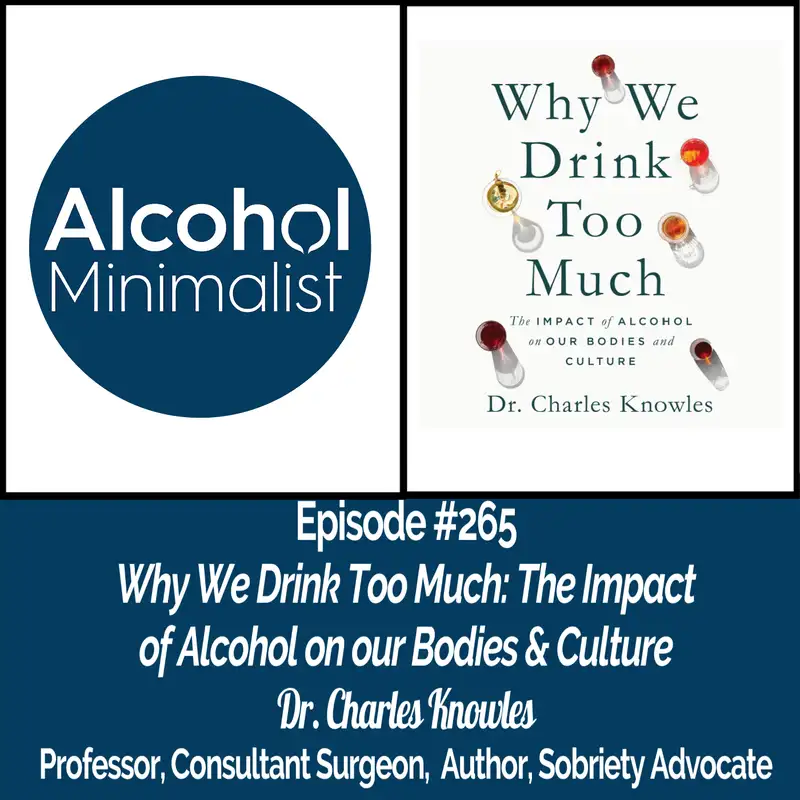
Why We Drink Too Much: The Impact of Alcohol on our Bodies & Culture with Dr. Charles Knowles
Welcome to the alcohol minimalist podcast. I'm your host, Molly Watts. If you want to change your drinking habits and create a peaceful relationship with alcohol, you're in the right place. This podcast explores the strategies I used to overcome a lifetime of family alcohol abuse, more than thirty years of anxiety and worry about my own drinking, and what felt like an unbreakable daily drinking habit. Becoming an alcohol minimalist means removing excess alcohol from your life so it doesn't remove you from life.
Molly:It means being able to take alcohol or leave it without feeling deprived. It means to live peacefully, being able to enjoy a glass of wine without feeling guilty and without needing to finish the bottle. With science on our side, we'll shatter your past patterns and eliminate your excuses. Changing your relationship with alcohol is possible. I'm here to help you do it.
Molly:Let's start now. Well, hello, and welcome or welcome back to the alcohol minimalist podcast. With me, your host, Molly Watts, coming to you from I'm gonna say it's a melancholy Oregon today. It's rainy. It's cold, kinda windy, mostly just rainy and cold, very typical, and gray.
Molly:Of course, typical of Oregon in the wintertime. I know I shouldn't complain because I've had a lot of dry days during the month of January. We're coming out of a mostly dry January here on the Alcohol Minimalist podcast, not talking about the weather, but, with regards to alcohol, and the weather has been, cooperating in that way too. So today, if you are listening to this in real time, it is Monday, February 2, and I am delighted today to share an interview with you. You know, I thought about it.
Molly:It's been a hot minute since I've had an interview on the show. And not because I haven't had opportunities, but I just, you know, wanna be careful about who I'm having on and and really thinking about those options. And so this opportunity was something I just could not pass by. I am talking today with doctor Charles Knowles, and doctor Knowles is a professor of surgery at the Queen Mary University of London. He is a qualifying as a doctor from the University of Cambridge.
Molly:He practices as a consultant colorectal surgeon as well. He has authored more than 300 peer reviewed publications and contributed to several major international surgical textbooks, but that is nothing about what he came on the show to discuss. He has written a book called why we drink too much, the impact of alcohol on our bodies and culture. And it is his first popular science book, and it talks about his own journey through becoming someone who no longer drinks and his sobriety, and he champions the idea now that problematic drinking is not a problem of the weak will or low moral integrity, and he believes that the term alcoholic should really no longer be seen as a dirty word and revealed only anonymously. Much like me, he wants to move the needle on people getting help sooner, and this book, I hope, will help some of you do just that with regards to learning about alcohol, learning about this is very science forward, so, of course, it really resonated with me.
Molly:And there's a lot to be taken away from his own personal journey, and like I said, lots of very good science in this book. I will link it in the show notes, why we drink too much, the impact of alcohol on our bodies and culture. Here is my conversation with doctor Charles Knowles.
Molly:Good afternoon, Charles, because it is, in fact, afternoon there in The UK. It's morning here in The US where I am. But no matter what time, I appreciate you taking the time to be on the alcohol minimalist podcast.
Charles:Thank you for inviting me to the show, Maura.
Molly:Absolutely. You're here because you have written a great book that I really want people to become familiar with and hopefully explore, why we drink too much, the impact of alcohol on our bodies and culture. And first of all, that's a big title. That's a big proposition to to endeavor upon. And so let's talk a little bit about what your goals were, how you came to write this book, kind of your story, and what led to it, and what you're really hoping the book will achieve for people.
Charles:Okay. So yes. Well, the book started out actually in a completely different form. It started out as a memoir.
Molly:Okay.
Charles:The memoir was the idea of my music producer who I worked with, Nick Talber, who produced then Rizzy, Marillia, a few other bands. And sitting in the studio recording things, and, obviously, you go over many stories. And he said, oh, you should write a book. So with this mad idea, I started writing a book. In fact, I finished writing a memoir.
Charles:And I showed it to a few people, including literary agents, who said, well, you know, it's not bad, but you'll never sell a memoir because unless you're a major celebrity. But the stuff you've written on alcohol is really interesting. So I went away and being that sort of person, I thought I must then write a book on alcohol. So it was back to square one. And I'm very good friends with Doctor.
Charles:Andrew Jenkinson who wrote the book Why We Eat Too Much. And so that's where the title came from.
Molly:Gotcha. The
Charles:best selling book. And and, yes, and I set off writing a book that started out because of its origins in a memoir really being about my journey and particularly what I call the why me question Mhmm. Which is why of all the people I grew up with, many of whom were heavier heavier drinkers than me, you know, crazier drinkers than me, did I end up developing alcohol dependence and all the problems that that's caused when they didn't. And many of them could take it or leave it despite, you know, considerable consumption. And what I realized, I'm starting to evaluate that, was that that question couldn't be answered without looking at a second question, which is why humans consume alcohol at all.
Charles:And indeed, that question, of course, expands to the rest of the animal kingdom as well. Why do animals consume alcohol as many of them do? And so the book then became an exploration of why we drink and really why some people are at a risk of having a greater loss of control than others. And I can tell you that those two questions together are not simple to answer.
Molly:No.
Charles:No. And there were many times in writing the book where I regretted starting it because of the complexity of it and because of the need to integrate things that fell well outside my comfort zone. So whereas, you know, medicine and neuroscience, can deal with. But by the time we got into sort of sociology, anthropology, history, psychology, that was you know, there was a lot to read and digest. So that's why that's how I came to to write the book.
Molly:I love that. I I appreciate the fact that you already set a stage for the fact that this question, why me, and the answer that potentially you were looking for is complicated. Right? It's not a one size and not a one answer fits all, and I think that's what I appreciated. I appreciate the fact there's a lot of science in your book.
Molly:Everybody around here at Alcohol Minimalists knows that I'm a science nerd, and I like all of the I like the science. I like the science for a lot of reasons, and one of the most important reasons is that I used science myself to help guide and change my narrative that I had had for a long time around alcohol. I often give the example of the fact that I, for a long time, believed believed that I needed to drink to relax and unwind. When I did not understand the neuro the neuroscience of it all and the fact that just I think in in your book, you say it, everything that goes up must come down, and it's the the fact that the rebound effect of over drinking is the excitatory neurotransmitters. And so I never understood that.
Molly:And when I didn't once I understood that, it became easier for me to challenge my own narrative. So this book you wrote after the fact. When I say after the fact, I mean after you became sober. So let's talk about that a little bit, because when you were changing your relationship with alcohol, it doesn't sound like it was based in science as much as it was for me, but I found science very helpful. In writing this book, did you go back and you realize along the way, like, okay.
Molly:This what this science actually supports things that I made decisions around, and it it definitely supports what I've done.
Charles:Yeah. So the answer to that is yes, the short answer. I think that there isn't a necessity for everyone to address the why me question at all. Mhmm. And amongst those of us who have addressed it, there isn't a necessity to address it through science.
Charles:And that will suit some people and not others depending you know? And I think actions are more important than thinking very often in in certainly, people suffering from alcohol dependence. You know, it's difficult to think your way out of a thinking problem, and it is a thinking problem. And so getting on with, you know, you've had a background of cognitive behavioral therapy, etcetera, getting on with things that are actually a program that involves action and work is, you know, often more important than solely thinking about it. A.
Charles:A. Gill describes this beautifully in his book, Poor Me, the why me question, which he addressed, you know, quite a long time into sobriety as I did. Mhmm. And I don't know if you've ever read his book, but it starts with the two boats. AA Gilles, a journalist and author in The UK, writes absolutely beautifully.
Charles:I mean, I'm not a patch on his quality of English literature. But the his book starts with two boats being you're stranded at sea in a small boat being tossed around by the waves and, you know, the sharks are circling, and you're awaiting your eventual end. And you're visited by two boats. One of the boats will take you to safety, and the other will tell you how you got there. And and you can only choose one of them.
Charles:And I think for many people, there's an element of choosing the boat that takes you to safety before you worry about how you got there.
Molly:Sure.
Charles:And, certainly, that was my experience. And so so but I think on the other hand, I have met people whose whole recovery has been based around understanding the science of why they train and develop the problems they did. And there's been a a play doing the circuits in The UK in theater houses called the white chip. And the white chip is exactly about a person who finds a solution, who has tried AA and all other things, but actually finds a solution from understanding their their brain and, you know, the neuroscience that's in my book and, you know, and you've mentioned. So I think there are many different roads to roam here.
Charles:But the certainly, I could you know, I I'm a scientist by background. I was always struggling to answer that question. It it just didn't help me very much early on, I don't think. We joke in AA, and I am a person who's benefited from AA. And I fully appreciate that, you know, your audience will include people who like or don't like AA or you know?
Charles:And I'm not here to advertise it. So that doesn't suit everyone. But the in AA, there isn't a chapter why it works. Mhmm. Mhmm.
Charles:How it works describes the 12 steps. Yeah. But there is no chapter in the AA big book that describes how a program actually works in the brain. Although, actually, the principles of AI are across now a number of all successful programs of changing thinking are pretty much based around the same thing, around changes in cognition and social support, etcetera, which, of course, were first embodied by the AA program in 1939. So, yeah, that's really so I'm I'm completely open
Molly:Yeah.
Charles:To different perspectives on that question.
Molly:Let's talk about your so that we set everybody up to understand your journey. And I I I'm curious too as we go into this. I know that there's you you kind of explored and and found different aspects, both genetically and upbringing and psychologically, things that you believe kind of fueled your path. Before we get there, I wanna ask you, because this is something that I've long that I've long held as a belief regarding alcohol, you know, alcohol dependence, and that is that you don't become physically dependent before first, you become psychologically dependent. Would you agree with that?
Charles:Oh, absolutely. Yes. Mhmm. So this is about the reward to relief shift. Mhmm.
Charles:And I think that's pretty well accepted that the the first problem ultimately comes down to really liking it. Mhmm. And if you really like something, you learn to do it, and you reinforce it much more than someone who likes it just a little bit. And and that is certainly the starting point of dependence later on, and, of course, where the real problems arise is where alcohol becomes a solution to the withdrawal from alcohol.
Molly:Right. The
Charles:physical impairment required for relief as well as for and often the reward aspect of alcohol is long gone by then. They're almost solely drinking for relief. And, of course, that is an incredibly strong driver of drinking. I mean, anyone who's experienced alcohol withdrawal, and I have more times than I care to mention, it's a horrible situation. You know, your brain will think of nothing else at all other than the obsession to have another drink.
Charles:It's incredibly difficult to overcome and and physically, you know, the the fear, anxiety, sweating, palpitations, everything. And and I think, you know, classic alcohol dependence and alcoholism, which is a word that I don't object to, and I describe myself as a recovering alcoholic. Again, not something that's essential or liked by everyone, but I think it says what's in the can. And in a way that, for instance, describing that I'm suffering from a severe alcohol use disorder doesn't, you know, when someone gives you a drink. The the alcoholism is that compulsion to drink, you know, a sometimes fatal disorder characterized by a compulsion to consume alcohol despite harm.
Charles:The basic definition of alcoholism or alcohol dependence. That compulsion is mainly based, I think, in its latter stages around withdrawal phenomena and relief drinking rather than reward because the reward is long gone.
Molly:Right. And I think it's important to mention. So this audience, you know, we are I always this is not if you if people if you believe that you are physically dependent, and I know that you say this in the book as well, it's very possible that someone that has developed a physical dependence on alcohol will require medical support to try to change that relationship or break that drinking pattern. And so this show really isn't intended for people that believe they have physical dependence. It's really more we're trying to catch people during that psychological dependence because it's very progressive.
Molly:And if you don't change that habit when you have it's very possible to slip to physical dependence. And so that's you know, I just wanna make sure, folks, you understand that that's if that's if you're listening
Charles:Yeah. And and and for the audience, let's be clear. There's only two to three percent of adult populations in the West have alcohol dependence as a medical condition. Whereas, there's the what's often termed gray area drinking now, but has other the hazardous alcohol use with what I call a reliance on alcohol, which we might say is a psychological dependence, is much more common, twenty percent. Just to pick you up on one thing, and I touch on this in my book.
Charles:And I can't say that I could categorically prove it, but I think it will be proven, is that one of the things that separates people in terms of risk of alcohol dependence is that there are a lot of people who will never develop withdrawal phenomenon because some of the biological differences between people that pose a risk are actually in changes in the brain that promote the the physical dependence. They I say in the book, we don't have all have the the same internal electrician in the brain when it comes to the rewiring. And I think there are people like myself that were prone to that rewiring and others that never will be however much they consume. Mhmm.
Molly:Right. Then, again, very small percentage, I'm sure, of people that would fit into that that description, but still worth worth paying attention to. And I think
Charles:that we're still trying to modify behavior.
Molly:Right. Exactly. Right?
Charles:Chance. Yeah. I'm not suggesting people carry on to find out. I
Molly:think Yeah. And I and I liked one of the the things in your book that I also appreciated. First, I mean, there's a lot of things that I appreciate, folks. I'm gonna link this book in my show notes, and I would really highly recommend you go out and read it yourselves. The thing that you that you made it pretty simple for people to look at because we're right here in the middle.
Molly:I'm I'm I'm recording this the middle of the of dry January, so we're you know, mostly dry dryuary, what do you wanna call it? We do a mostly dry January around here. I talk a lot about progress, not perfection. Always trying to prioritize alcohol free days. And you talked about the three dimensions, the c's of drinking as being a really good test or a really good kind of marker for people if they are looking at their own relationship with alcohol, those three c's might be a good place to start.
Molly:Can you describe for my audience what those three c's are?
Charles:Yes. I can. So the three c's are consumption, consequences and control. And I think many people there's there's an enormous fascination with the amount we consume.
Molly:Right? Always trying to quantify it. How much can I have? How much can I have?
Charles:Yeah. The and, I mean, I've noticed this recently in the the sort of news headlines of pieces that I've been, you know, in the papers. They're just obsessed with the amount I drank.
Molly:Right.
Charles:You know, the alcohol so, anyway, that's so the amount we consume is actually really a very poor indicator in many ways of the real problems of drinking alcohol. We all know people who can drink heavily and their righteous brain, take it or leave it. You know? If they had to stop, the doctor turned around and said, you've got a touch of fatty liver. Oh, just stop.
Charles:It's fine.
Molly:Right.
Charles:I know people like that in the music industry and things, you know, who drink with the best of them but could just stop. And then there are people who so it is worth, of course, looking at consumption against, know, government safe limits, etcetera. Right. But, of course, that's not easy because we all define units differently. Like, in The US, you have the standard drink.
Charles:That's 14 grams of alcohol. Where our unit is eight grams. Most of the world, it's 10 grams. And all governments have different limits.
Molly:Mhmm.
Charles:Ranging hugely. I mean, in
Molly:terms And there's a and there's there's tables in the books, everybody. And there's tables by Lots of good if you're if you're a data person, you wanna see all that, it's here. Sorry. Go ahead.
Charles:But I think the amount we consume is important from the long term chronic health consequences of alcohol. Here, I'm not talking so much about the brain, but about the body. Mhmm. So, obviously, amount consumed has a relationship with being overweight or obese and metabolic changes in the body. It has a relationship with heart disease, but particularly stroke and high blood pressure.
Charles:It has a relationship with the risk of cancer, particularly breast cancer and bowel cancer. And I could go on with a long list. So it's important from that point of view. But I suspect that only a fraction of people on your show are worried about developing liver disease or heart disease. They're here because actually the what they're really worried about is the consequence.
Charles:Mhmm. And this is one the things that characterizes gray area drinking or what the World Health Organization would describe as hazardous alcohol use. That is that in our the back of our mind somewhere, there is a niggling feeling that this really isn't doing us any good. Mhmm. And there are a few things that might not have happened yet but could happen if this persisted.
Charles:So I haven't crashed the car yet. I haven't lost my marriage yet. I've turned up irritable till late to work with a hangover, but I haven't lost my job yet. And there are a number of yet. Mhmm.
Charles:And we then get in a situation of sort of cognitive dissonance that there's one side of the brain going, go on. Have another drink. Be alright. You might do it. And there's another side of the brain going, I really shouldn't.
Charles:And and the gray area drinking sort of area of the population describes these phenomena. And so it is worth taking out a piece of paper and saying, what are the pros of my drinking versus the cons? What really are the consequences here? You know, does my skin look good? Am I really feeling great?
Charles:Am I doing enough exercise? I haven't got hang on. You know, you could write a long list, and that's the second c. Mhmm. The third c come is control, as I've said.
Charles:And the this is really an area where you I think someone can put it to the test. So let's just say that the first column shows a level of consumption that you're not terribly happy about over the safe limits, and the second column shows a number of things we're worried about. Then the well, that's fine. Okay. Just stop drinking for a while.
Charles:Maybe try January. Maybe it doesn't have to be January, but anytime. Then you find it's not as easy a habit to break as you thought it might be. And there we're into the third c, control. Mhmm.
Charles:And control has, on one end, white neutrality around alcohol, the ability just to be able to take it or leave it. The black is alcohol dependence or in old man's terms, alcoholism. And the gray area is in the middle. And what I've described for the first time is term alcohol reliance because the currently, the medical profession and psychology totally disenfranchise this middle group. Gray area drinking is not a medical term.
Charles:You will not find it anywhere. If you went to your doctor and said, I'm a gray area drinker, you just be
Molly:You wouldn't know. Right.
Charles:Like expression. But this is important because as I've already said, it's probably twenty percent of adult populations fall in this group. And so I've described this term alcohol reliance. It's the know, I rely on a drink in generally in certain situations after work to destress or to socialize or you know? And I give a list of the most common Yep.
Charles:Descriptions of people use in the book that I rely on a drink to. Hence, I've used the word alcohol reliance. And I think gray area drinking, which I define really in the scientific way for the first time in the book, is a person who relies on alcohol in a way that they've come to worry about the consequences of their consumption and their ability to control it. Yeah. And that encompasses the three c's.
Molly:I like that.
Charles:Think we would probably find that many of your audience would consider they fell in that group.
Molly:Without without question. I mean, that's the that is the people that I that I really focus on and the people that are here listening. And people that are listening and that have been listening for a while to my my show will recognize kind of the the characteristics of alcohol reliance as being very similar to what I call the alcohol core beliefs. I say alcohol the ACBs. They are the as I described to you, the belief that I needed to drink to relax and unwind.
Molly:And so that kind of core belief drives that habitual behavior. And so that or that, you know, automatic behavior. Right? The behavior that we've stopped questioning, the behavior that we just do. And I think that's you know, I I know that you would agree with me on this.
Molly:One of the the real beauties of things that have happened in the world, at least in my opinion, over the last five years, maybe maybe longer than that, but certainly in the last five years, is this new shift towards sober curious actions and exploration of relationships with alcohol while people are in this they may not have the words for it, the gray gray area drinker. That's something that's still pretty, you know, new in the in the in the zeitgeist, but it is definitely coming around. But I think the idea of being sober curious and being a mindful drinker and actually looking at the relationship with alcohol is something that we should all be really grateful for because it's certainly taking people in a new direction that I don't think maybe existed five or so plus years ago.
Charles:Well, I I totally agree with you on all points.
Molly:Hey. Just a quick break to talk with you for a minute about Sunnyside. You hear me talk about it on the show often, and it really is my number one recommendation for a mindful drinking app. People use this tool in my groups, in my classes, and they tell me all the time how much they really appreciate the fact that Sunnyside is a very positive reinforcement. And what I mean by that is that when you track your drinks, and let's just say you planned for one drink and you ended up having two.
Molly:If you're honest and you track that second drink, you're not going to get a message that shames you in any way or reprimands you. You're actually gonna get positive reinforcement for tracking a drink that you didn't plan on and some ideas and some suggestions for maybe going and grabbing a snack or getting some water. Sunnyside is like having a coach in your pocket, and I love that. You can try it for a fifteen day free trial. Go to www.sunnyside.co/molly to get started today.
Charles:And I think when I think back to when I was young compared with the youth of today, I mean, there's been a sea change. I don't think I knew anyone who did a trick.
Molly:Well and you UK folks, you guys that I I've talked to I you know, I know on the back of your book, you have a quote from Will Porter, and I've talked to Willie Porter. I've talked to Claire Pooley. I mean, there is definitely a culture around young youth drinking in The UK that I feel like is maybe a little bit was a little bit even more permissive than The United States.
Charles:Yep. No. That is and, mean, the figures bear that out. We do have more problem with alcohol in The UK. At least more of us drink regularly in The UK than I think it's 80% of adults in The UK and 65% in The US.
Molly:Yeah. Not to say that, like I said, there's plenty of people in both in both pools that that need to that can benefit from looking at at changing their relationship with alcohol. One of the things that I also appreciated about this book is that many books come at this at this question from a real black or white perspective. You either are or you're not. You're very you know?
Molly:And and the that the that the solution for everyone is simply to not drink. Like, that's the way we solve this. We don't drink, and therefore, why isn't everybody just not drinking? And I appreciated the fact that you were very careful to, like, say that there is no one one solution fits all, and there's room for all of us because I for me, personally, and I've said this many times on the show, people have heard me, it's like I did not feel capable or the the thought when I tried to think, I'll never drink again, that very thought, like, I can never have a drink again, would prevent me from doing anything. It would prevent me from trying it all.
Molly:And so my approach was different than yours, but I also never got to the point where I think that and we never really touched on this, your story, but you've got to a rock kind of what you would have described maybe as a rock bottom point. Not that everybody needs to wait that long, but for you, do you think that it you got there that it needed to get there?
Charles:Yeah. I do. I mean, to come back to your earlier point, it's not just something I've written in the book. I firmly am not anti alcohol. Right.
Charles:You know? I I I think there is room for alcohol in society. I think people should be educated. You know, as adults or children starting from childhood, we should be afforded the opportunity to make a rational decision whether we wish to do it based on having more information than we're given at the moment. And, certainly, there are, you know, governments and the alcohol industry have not done a great deal in this regard, And alcohol is widely accepted and and completely normalized Mhmm.
Charles:You know, as a way of living.
Molly:And and almost glamorized in many ways. Right? I mean, there's a lot of I talk a lot about that about this the stories, the narratives that are driven both by by, you know, I mean, big
Charles:alcohol alcohol. I was alcohol dependent. I needed to get to rock bottom before this was gonna change. But, I mean, that is not a path I would recommend anyone else taking. The you know, it was not much fun at all.
Charles:But the no. I think there's a middle road. And I think people should have be sober curious. Have a look. Don't accept just what you, you know, you grew up with or were told and and, you have an approach to looking at this.
Charles:I I you know, you've had William Porter on the show. William Porter is amongst people I would describe as being evangelical about mean, I know Sam very well. I know know and he's a friend of mine, but but we would disagree on his approach.
Molly:No. And and and he came on, and we did dis I mean, we talked about it. And I but he was but what I appreciate about William is that he is open to having that conversation because we both believe that having the conversation and continuing to explore both sides is what helps more people. So and that and that we can completely empty.
Charles:Has helped a lot of people.
Molly:100%. 100%.
Charles:And, you know, his books have have certainly rung a chord with many people who they've helped great. I mean, I I just think the fundamental of of why humans have had the relationship they've had with alcohol and the startingness of food stuff in our ancestors millions of years ago, but fifteen thousand years of deliberate alcohol manufacture is that the fundamentally, for most people, it's fun. Mhmm. And I do not want wish to rid the word or the world of having any fun with alcohol.
Molly:Right.
Charles:It's you know, that and that's, you know, that is at its heart. Alcohol has psychostimulatory effects that are basically fun, and the behavior that can be derived from that for people is often regarded as pleasing and therefore reinforces the behavior, and we learn to drink on that basis.
Molly:Yeah. I I share a lot about the actual therapeutic effect of alcohol being very limited with the blood alcohol content being from zero to 0.055%. And the problem is that we try to chase that number, and we chase it by drinking more, which, of course, raises our blood alcohol content, which then just has a propensity for all the negative consequences that come from drinking. Right? And so that's why the show is called alcohol minimalist because, really, the the answer is that drinking less is better, and there is really no situation where drinking more is going to improve your consequences, improve your outcomes.
Molly:Right? It's just not. And if you really want to include alcohol in your life, if you want to include it and if you are not someone that has developed a physical dependence, then you're going to want to minimize it. So Yeah.
Charles:I mean, one thing to be clear is I think people like me who have developed alcohol dependence, I think ninety nine point nine percent of the medical profession, psychiatrists, you know, support organizations and things would agree that you can never safely drink again. But as I've mentioned, the we are a small proportion of the population.
Molly:You have in the book, you have by what you say is not is is not a homage to AA, but you have 12 guiding principles. Not the 12 steps, but you have 12 guiding principles. I'm not gonna go through all of them, but one of the things that I that you wrote that I really liked, and it's the it's the guiding principle number nine, and it says abstinence, neutrality, and sobriety are not the same thing. And in it, you say, sobriety is a state of mind that embodies both neutrality and the achievement of some form of serenity or peace. It denotes a state of mind exhibited by people who have who have achieved a successful balanced life with aspects of mental, physical, and spiritual health.
Molly:And I say that's what I say here. It's I talk about having a peaceful relationship with alcohol. I think that one of the things that people that's why I think I I went the path that I've done is people often equate sobriety and apt or abstinence with with that feeling of peace. And what I would posit to you and I would ask for your opinion on is, was it the abstinence that brought you peace, or was it what you've done with regards to the exploration of understanding how you got there and really coming into a whole new practice of mindfulness and all the things that you've built after achieving and understanding that for you, because you were physically dependent, you had to remove the alcohol to even get to a point where you could do all this work. Right?
Molly:I talk about doing the work underneath. We have to understand what drives us personally and and fix what's there to be able if we don't do that, then it's potential that we'll just change to another form of coping.
Charles:Yeah. So I won't surprise you. The answer to that question is that abstinence brought me seven years of misery.
Molly:Okay.
Charles:Yeah. So abstinence without trying to address the change in thinking and achieve some form of peace with myself is a very, very difficult position to be
Molly:in. Right.
Charles:And was the worst years of mine even though I wasn't drinking very much. But it was the yo yoing back and forth and the mental health consequences of not drinking while still having the desire to drink and not resolving any of those other problems. You raise an interesting perspective. Can someone be sober and still drinking? I think the answer to that question comes back from the the, you know, the the origin of the word sobriety.
Charles:Mhmm. And the origin of word sobriety can be traced back, you know, over a thousand years and is used actually in English literature for the knights of King Arthur. I mean, to give you an idea of how far back it goes. Yeah. And I suspect they were drinking.
Charles:King Arthur is described as being sober of mind. It's used by Shakespeare. It's used by Thomas Hardy. And these not in the context of being alcohol free Mhmm. But of being but of being of sober mind.
Molly:Emotionally sober. Is that the Emotionally sober.
Charles:Yeah. Now in gray area drinking communities, they use the term emotional sobriety to denote a state that develops once, you know, the drink has been put down. Mhmm. In AA, that's just called sobriety. So Right.
Charles:So in AA, you would not describe someone who had stopped drinking as being sober. You've most people have stopped drinking when they come to an AA meeting. Mhmm. Getting sober is the next years.
Molly:Okay. Okay.
Charles:So that you can be neutral around alcohol and that the the will to drink is no longer there because some form of serenity has been achieved. And if I look at my life, you know, when I first came across the word serenity, which people mostly don't unless you go to AA because it's not a word that's commonly used in the language, I realized that I had never had any inner peace ever in my life Mhmm. Until I found that eventually where suddenly I realized, wow. I actually feel okay. Mhmm.
Charles:And the desire to drink has never ever come back.
Molly:Mhmm. I think
Charles:And so it's much more than stopping drinking.
Molly:Right. And now I've done plenty of extended periods of being alcohol free. You know, I do them regularly or or I do them pretty, you know, pretty frequently, I should say, and I have many alcohol free days each week. And so the the the alcohol has become kind of a nonfactor in that regard of my life, but I do believe that I would have never gotten here had I not been willing to explore how the whole emotional resilience, emotional sobriety, that part, the connection and I I talk a lot about how our thoughts drive our feelings, which drive our actions and get the results that we have in our lives. But the feelings part, the feelings, right, there, it's at the center of our lives.
Molly:We we we focus so much on our emotional state and and but we don't really understand it very well. We don't understand how we get there, and we also don't understand how much agency we have in determining how that how that plays out. We blame a lot of our lives on the circumstances and don't really understand how much agency we have. So I think that without that's that's the difference. Right?
Molly:I think that's what helps people actually, and it's whether you change the you know, become somebody who drinks not at all or certainly somebody that no longer drinks on a habitual pattern basis or regularly. The the doing that work, underlying the understanding, the underlying part is what eventually will bring the peace.
Charles:Yeah. I mean, I think every program, whether you seek to be alcohol free in the long term to moderate or anything else, the principles of sobriety or emotional sobriety are the same, that there are three established pillars and probably a fourth one. And the three established pillars are cognitive, a change in thinking Mhmm. Social, a change in, you know, social support. And the third is addressing the underpinning psychological drivers why we were drinking or or or exacting the behavior in the first place.
Charles:And the fourth one is spiritual Mhmm. Which helps some people and not necessarily everyone.
Molly:In the back of the book, you talk about the myths of AA, and one of the things that I think people often attribute AA to being is a religious organization and as opposed to a spiritual organization. And I think that that delineation is important, So I appreciate you putting that in the book. I think that whether it's a, you know, a greater being or just being more mindful in in meditating and and being in touch with your own, you know, the own spirituality, I guess, for lack of a better definition, is something that I do believe helps everybody. And, certainly, something that you wrote, and this is the very end of your book, you you talk about being asked about having regrets, about regrets for the road that you took. And you said that from my own perspective, my experience of rock bottom and what I have learned in recovery have brought me a new level of humility and peace that I might not have ever found without it.
Molly:So talk to me about that in terms of just as this final words on this conversation. What has your life chain in this last ten years, how has your life changed in terms of the humility, the peace, and where that where that confluence of all of, you know, all the past and now the present comes together into what you are hoping you know, what you what you believe about the the world and where you are with it?
Charles:I'll unpick that question. The the I mean, what it's brought me is a, I think, a perspective on my life and who I am that I didn't have before. And that perspective, obviously, is mirrored in my relationships with other people, including my wife, my children, my friends, my professional career. I think I'm a better doctor because of the empathy and humility I've gained from this experience. You know, Carl Jung said that it's the wounded doctor that heals.
Charles:And there's sort of no area of my life that's gone untouched. Now that's not to say that life is perfect beyond that. Of course, it isn't. You know? Shit still happens to people.
Charles:I've had operations and other things. I'm still treated for depression. You know? I still have ADHD. You know?
Charles:Those sort of things have to still present in my life, and they always will be probably. But peace is an incredibly important thing. And it wasn't it's not until you get it, you realize you never had it. Mhmm. Mhmm.
Charles:I mean, that that is the extraordinary thing about it. And one of the things that, of course, I started drinking as a teenager, and I stopped in my forties for the first you know, eventually. And, you know, the good 30 of drinking in that. And one of the other perspectives here, particularly for people like me who've been drinking a long time is that you may not actually know who you are. Mhmm.
Charles:And this is a thing that people don't talk about because the last actual sober version or nonalcohol affected version of you was when you were a teenager. Every relation interaction things has been shaped. The our very lives have been shaped by the relationship with alcohol. And I think it didn't find its way into the book because the editor didn't like it, but I did have the quote from Shakespeare in there that who is it who can tell me who I am, which is a quote from King Lear. And the fool says, you are your own shadow.
Charles:And I think one of the important things is for people to you know, in looking back is to not just be the person they're not. Mhmm. So, you know, I am no longer my drinking persona. You know, that makes me no one. You know?
Charles:So finding who you really are is something that can be achieved out of the other side of this. And I just think that's very difficult to do if you're still drinking substantially. It's one of the reasons that I think regardless of anyone's ultimate aims in modifying their relationship with alcohol, a period of being alcohol free is incredibly helpful
Molly:Mhmm.
Charles:To gain some perspective on things, you know, that and then that continues. But there's you've described it as the work. Mhmm. The work. You know, the work hasn't stopped for me.
Molly:Yeah. I don't I I think that's the Yeah. I I yeah. I say that all the time. It that's what I think the beauty of when I say the work.
Molly:This this change, this kind of change that for me really wasn't just I say it all the time. It's about becoming a better thinker. It's becoming a better mind manager. It's actually learning how to work with my brain and not against it. And Yeah.
Molly:That whole I mean, that is a lifelong journey. Right? I hope that I always want to keep evolving into a better version of myself and into becoming and realizing that I have the agency to do that and not believing my self limiting beliefs, not believing the narratives that I had held on to for so long. And I think that is what is on the other side of changing a a habit that no longer serves you, whether it's a drinking habit or any other habit that is of consumption that is taking you away from being you know, from from finding out who you really are. Right?
Molly:So I love that. And, doctor Charles Knowles, thank you so much for spending time with me here on the Alcohol Minimalist podcast. If people want to learn more about you, is there a place where they should head head look for you?
Charles:Yes. So well, at the moment, it's pretty much the book and other podcasts and Mhmm. Other available resources. But with my wife's assistance, we are developing a website that will have a number of other resources on it, including q and a and addressing topics. And I'm hoping that I will do a scientific update on it every few months.
Charles:So new scientific papers that I think moves the needle from journals like The Lancet or Nature, the on addiction and other things. I'll write a short summary. I'll read them and write a short summary on that for people.
Molly:Wonderful. Well, when that becomes live, you'll let me know. I will definitely update my listeners and readers with it. And I just, again, appreciate you taking the time. I'll put everything in the show notes, folks.
Molly:And, doctor Charles Knowles, thank you so much.
Charles:A pleasure. Thank you.
Molly:Thanks for listening to the Alcohol Minimalist podcast. Take something you learned from this week's episode and put it into action. Changing your drinking habits and creating a peaceful relationship with alcohol is 100% possible. You can stop worrying, stop feeling guilty about overdrinking, and become someone who desires alcohol less. I work with people in two different ways, and you can learn about them over at my website.
Molly:Go to www.mollywatts.com/work with me, or reach out to me directly. Shoot me an email, molly@mollywatts.com. We'll jump on a call and decide what might work best for you. This podcast is really just the beginning of our conversation. Let's keep it going.
Molly:If there's one thing I know, it's that change is way easier, and you stop trying to do it alone.